Sammy Credenza
 For children
 Linen & Light
 Concrete & Grain
 First Room
 Cafés, shops, offices
 Rooms and nooks, fitted
 Our story
Built-in furniture is fixed to the walls of the home and stays when you leave; freestanding furniture stands on the floor and goes with you. In Dubai, where most people rent and move every few years, that single difference decides more than any question of style. Built-in wins on wardrobes, television walls, kitchens and the awkward spaces nothing standard fits. Freestanding wins on everything you want to keep, everything a child will outgrow, and every home you do not own. This guide sets out the honest trade-offs, where each one wins, the hybrid approaches that get most of both, and what to send us if you are thinking about commissioning joinery.
The honest trade-offs
Tenancy and moving
Fixing furniture to the walls of a rented apartment needs the landlord's agreement, and most tenancy contracts ask for the walls to be put back as they were at the end. Read yours before you plan anything built in. Even where it is allowed, a built-in wardrobe or shelf run is a gift to the next tenant. Freestanding pieces are yours: a sideboard bought for a Marina flat goes to the villa in Mirdif and then to the townhouse after that. If you own the home, or you are staying for years, the calculation changes and built-in starts to make sense.
The fitted look
Built-in is the only way to get furniture that runs from floor to ceiling and wall to wall with no gap on top for dust and no strip of tile showing at the side. It makes a room look finished in a way a row of freestanding cabinets cannot quite match, and in a small apartment that floor-to-ceiling line makes the room feel taller than it is. If the look is the point, built-in is the answer.
Budget flexibility
Freestanding can be bought a piece at a time. The sideboard this month, the cabinet when the bonus comes, the desk when the spare room becomes an office. Each piece can move between rooms as the home changes. Built-in is a project: one drawing, one sum, one fitting, and the decision made once for the whole wall. That is more efficient if you know what you want and harder to undo if you do not.
Timelines
A freestanding piece is made in the workshop and delivered; the lead time is shown at checkout and the day it arrives it is in use. Built-in joinery starts with a site visit to measure the wall as it really is, then drawings to agree, then making, then a fitting day at the property, sometimes with an electrician if the television wall needs sockets moved. It takes longer and it involves your home, not just your doorstep. We confirm the timeline once we have seen the wall, because the wall decides it.
Where built-in wins
- Wardrobes. A bedroom wardrobe wants to be as tall as the room, and a floor-to-ceiling run on tile with no dust gap above and no cleaning gap below is a built-in. Many Dubai apartments come with one; where they do not, or the developer's version is shallow and badly divided, joinery fixes it.
- Television walls. The screen, the boxes, the cables, the shelving above and the storage below all want to be one composition. Built-in hides the cables inside the joinery and puts the sockets where the equipment is.
- Kitchens. The same logic: fitted to the wall, with plumbing and power inside.
- Under stairs, alcoves and half-height walls. A villa staircase or the alcove beside an apartment's kitchen units is a shape nothing off the shelf fits. Joinery made to the space is the only thing that uses it.
- Home office walls. A desk run with shelving above, made to the wall, in a room that is going to be an office for years.
Where freestanding wins
- Anything you want to keep. The pieces you will still own in ten years are the freestanding ones.
- Rented homes. Which in Dubai is most homes.
- Children's furniture. A child's wardrobe should be low enough for the child to use and should move to the next room when the next child arrives. The Sofi kids' plywood wardrobe is made at a child's height so they can dress themselves, and it goes to the next bedroom, the next apartment, and the younger sibling. A built-in wardrobe in a nursery is a wardrobe for an adult who is not there yet.
- Height without fixing. A tall freestanding cabinet gives a corner the vertical storage of a built-in and comes with you. The Zoe tall plywood side cabinet does that in a dining room or at the end of a living room: cupboard height, slatted doors with the end grain showing, and nothing fixed to the wall except an anti-tip strap.
- Dining and living room storage. Sideboards and credenzas are freestanding by nature. They want air at both ends and a top you can style.
- Changing your mind. A room you are not sure about yet is a room for freestanding pieces you can move on a Saturday.
Built-in or freestanding, side by side
| Consideration | Built-in joinery | Freestanding furniture |
|---|---|---|
| Moving house | Stays with the property | Goes with you |
| Rented home | Needs landlord agreement; reinstatement at the end | No permission needed |
| The fitted look | Floor to ceiling, wall to wall, no gaps | Air around each piece; reads as furniture |
| Budget | One project, one sum, decided once | A piece at a time, moved between rooms |
| Timeline | Site measure, drawings, making, fitting day | Made and delivered; lead time at checkout |
| Awkward spaces | Uses every centimetre of an alcove or under-stair | Standard sizes, adjustable within limits |
| Cables and power | Hidden inside the joinery, sockets moved | Run behind the piece |
| Children | Sized for the adult the child will become | Sized for the child now; moves to the next room |
| Changing your mind | Hard | Easy |
| Best for | Wardrobes, TV walls, kitchens, alcoves, office walls | Sideboards, cabinets, desks, kids' rooms, everything you will keep |
Hybrid approaches
Most of the homes we work on end up with a mix, and the hybrids are often the best answer.
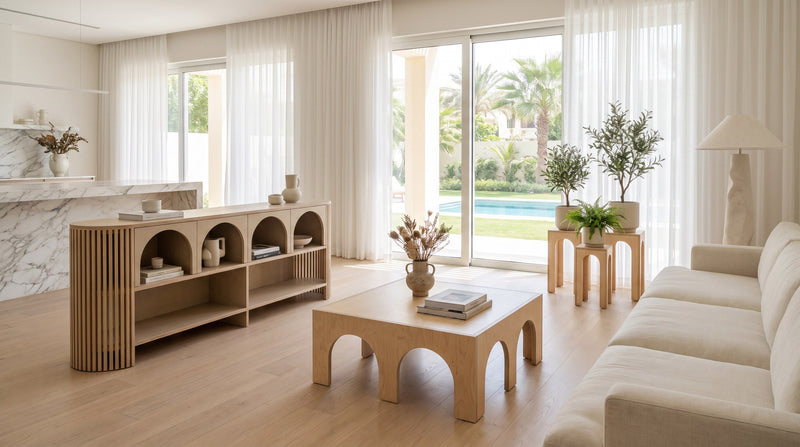
Freestanding below, built-in above. A television wall with a freestanding credenza under the screen and a run of made-to-wall shelving fixed above it. The shelves stay; the Sammy plywood credenza comes with you. The cables run behind the credenza rather than inside the joinery, which is a small price for keeping the piece.
Made to the wall, not fixed to it. A run of cabinets cut to the exact length of the wall, stood side by side, with a top that spans them. From the sofa it reads as fitted. At the end of the tenancy it unbolts into pieces and goes in the van. This is the answer for a rented apartment where you want the fitted look on the dining wall without a conversation with the landlord.
Fixed for safety, not for fit. Any tall freestanding piece in a home with children should be strapped to the wall against tipping. That is a small bracket and a screw, not a built-in, and it comes off with a filler pen's worth of reinstatement. We would rather you fixed a tall cabinet and left a screw hole than left it loose.
How we handle larger projects, and what to send us
Whole rooms, built-in joinery, nurseries, home offices, cafés and schools are handled personally, by us, from the first message to the fitting. We have furnished nurseries, schools and family homes across the UAE, and the process is a conversation rather than a form. Our guide to ordering custom furniture in Dubai walks through the stages; here is what makes the first message useful.
- Photographs of the wall, from straight on and from the side, in daylight, with the floor and ceiling in the frame.
- Measurements: width, height and depth, and the position of sockets, the AC unit and its drain, the thermostat, skirting and any reveal. Rough is fine to start; we measure properly before anything is cut.
- A rough brief: what it has to hold, which room, the finish you are leaning towards, and if you own or rent.
- Timing: a move-in date, a baby due, a tenancy ending. We plan around real dates.
- The building, for access: lift size, parking, whether the site is occupied.
Send that on WhatsApp or through the contact page and we will come back with questions, then a sketch. Custom work is paid as a deposit to start and the balance before delivery, with the drawings agreed first.
From the workshop
The difference between built-in and freestanding on our bench is not the material, which is the same sealed birch plywood either way, but where the last cut happens. A freestanding sideboard is finished in the workshop, squared, sealed on every face and edge, wrapped and delivered. A built-in is finished as far as it can be, then scribed on site to walls that are never quite straight, because no Dubai wall is: the tile has a fall, the skirting is a different thickness at each end, the AC drain sits where the cabinet wanted to be. The scribed edge is sanded and sealed on the day, standing in your room, so the face that meets the wall is protected like every other. It is slower and dustier than delivering a finished piece, and it is the reason we visit before we quote.
Frequently asked questions
Is built-in furniture worth it in a rented Dubai apartment?
Rarely, unless you are staying for years and the landlord agrees in writing. You will leave it behind and may have to reinstate the walls. Made-to-wall freestanding pieces give most of the fitted look and come with you.
Does Plyconcept do built-in joinery?
Yes, as part of larger projects handled personally: wardrobes, television walls, under-stair storage, shelving runs, home office walls, nurseries and commercial spaces. Start with photographs and measurements on WhatsApp.
What should I send for a joinery quote?
Photographs of the wall from straight on and the side, rough width, height and depth, the position of sockets and the AC unit, a short brief on what it has to hold, and any real dates. We measure properly before cutting.
Can freestanding furniture look built in?
Largely, yes. Cabinets cut to the exact length of the wall and stood side by side read as fitted from across the room, and unbolt into pieces when you move.
Do tall freestanding pieces need fixing to the wall?
Any tall piece in a home with children should have an anti-tip strap. It is a bracket and a screw, not a built-in, and it leaves one small hole to fill.
How long does a joinery project take?
It depends on the wall, the size of the run and whether electrics are involved. We confirm a timeline after the site visit, once the drawings are agreed, rather than guessing before we have seen the space.
Talk to the workshop
If you are weighing up joinery against pieces you can take with you, send photographs of the room on WhatsApp or use the contact page and we will tell you honestly which we would do in your position. Larger projects are handled personally from our own Dubai workshop. For workshop news and new pieces first, the newsletter sign-up is in the footer.