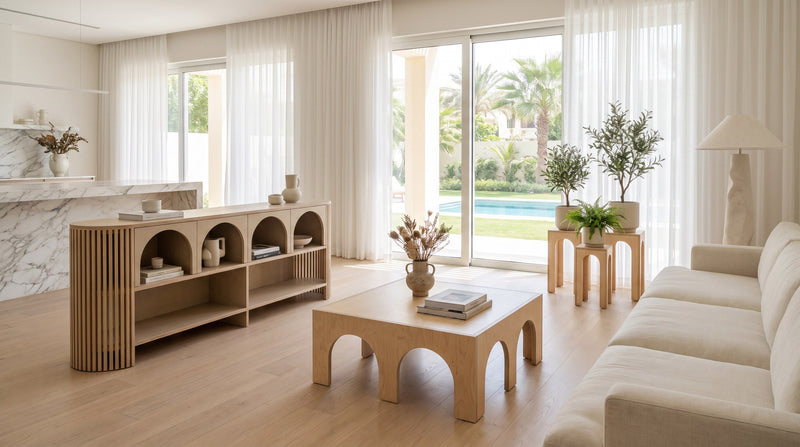
Sammy Credenza
 For children
 Linen & Light
 Concrete & Grain
 First Room
 Cafés, shops, offices
 Rooms and nooks, fitted
 Our story
A sideboard in a Dubai home is sized by the wall, not by the catalogue: measure the wall, subtract space for the doors to swing and for you to stand in front of them, and choose the longest piece that leaves the room breathing. Sideboards, credenzas and side cabinets are three heights of the same idea, and which one you want depends on whether the piece is going under a television, behind a dining table, along a hallway or beside a bed. This guide covers the words, the door logic, the walls, and how the four finishes sit against the pale interiors most UAE apartments and villas come with.
Sideboard, credenza or cabinet: what the words mean
People use the three words loosely, and that is fine, but they do describe different heights. A sideboard is roughly waist height, with doors and usually a shelf inside, made to stand against a dining or living room wall with things displayed on top. A credenza is lower and longer, the height that puts a television at eye level from a sofa, often with a retro profile. A side cabinet is taller than both, closer to a cupboard, for a corner or the end of a room where you want storage going up rather than along.
In our range the Boho Soul plywood sideboard and its sibling the Eclectic Soul sideboard are sideboards, the Sammy plywood credenza is a credenza, and the Zoe tall plywood side cabinet is the cabinet. The Jeffrey open sideboard sits at sideboard height but has an open arched front instead of doors, which changes what it is for. Dimensions for each are on the product pages.
Measure first, then choose
- Measure the wall from corner to corner, or from the corner to the nearest door frame or window reveal.
- Note anything on the wall: sockets, the AC thermostat, a switch plate, a curtain stack. A piece can sit in front of a socket; it cannot sit in front of a thermostat.
- Stand where you would open the doors and look at what is behind you. A dining chair pushed back, a sofa arm, a corridor. That gap is fixed; the piece has to leave it.
- Decide whether the top is for use or for show. A serving surface behind a dining table wants length. A television wants a piece longer than the screen.
- Then pick the longest piece that leaves the wall with air at both ends. A sideboard jammed corner to corner reads as built-in and loses the point of being a piece of furniture.
Two, three or four doors
The Boho Soul and Eclectic Soul come in two-, three- and four-door versions, and the door count is the length. The logic is simple once you see it in a room.
- Two doors is a short wall, a hallway, a bedroom, or the end of a run of kitchen units in an open-plan apartment. It holds table linen, the printer, the things a small flat has nowhere else to put.
- Three doors is the most common choice for a dining wall in a Dubai apartment: long enough to serve from and to display on, short enough to leave the chairs room to push back.
- Four doors is a villa dining room, a long living room wall, or a television wall where the screen is large and the piece needs to be longer than it. It anchors a room that would otherwise feel empty at one end.
The Sammy credenza comes in two lengths, the shorter for an apartment television wall and the longer for a villa family room, and the Jeffrey sideboard in Regular and Lungo on the same principle. Exact dimensions for every version are on the product pages, and if none of them is right for your wall, that is a conversation we have often.
Which wall
The dining wall
The classic place for a sideboard, and the one where length matters most. Behind a dining table the piece should be shorter than the table so the room reads as table first, sideboard second. Leave room for the chairs on that side to push back with the doors closed, and think about the top: a serving surface at a Friday lunch, candles and a bowl the rest of the week. Doors rather than an open front, because the dining wall is where the things you do not want to look at live.
The television wall
Lower is better. A credenza puts the screen at the right height from a sofa and leaves the wall above free. The piece should be longer than the screen by a comfortable margin on each side, otherwise the television looks perched. Cables run behind; a credenza a hand's width off the wall hides them without a cut-out. The Sammy was drawn as a TV console as much as a credenza, which is why it is the length and height it is.
The hallway console
Apartment hallways in Dubai are narrow and the front door often opens straight into them. A two-door sideboard or an open piece like the Jeffrey works as a console: keys and post on top, shoes or bags below. The rule here is depth rather than length; you need to pass it with a suitcase. Rounded corners matter more in a hallway than anywhere else in the home, because hips find them.
The bedroom and the corner
A tall cabinet earns its place where floor space is short and wall height is not. The Zoe is a cupboard first, a drinks cabinet second, and either way it goes in a corner of a living room, at the end of a bedroom, or off a dining room where a sideboard would block the route. Its slatted doors show end grain, so the front is texture rather than a flat panel, which matters when a piece stands tall in a pale room.
Room by room
| Room or wall | What works | Why |
|---|---|---|
| Apartment dining wall | Three-door sideboard | Serving length without blocking the chairs |
| Villa dining room | Four-door sideboard | Anchors a long wall; storage for a family's worth of linen and serveware |
| Apartment TV wall | Credenza, shorter length | Screen at sofa height, piece longer than the screen |
| Villa family room | Credenza, longer length | Carries a large screen and the boxes underneath |
| Hallway or entrance | Two-door sideboard or open sideboard | Shallow, passable with a bag, a surface for keys |
| Home office | Open sideboard | Files and printer reachable without opening a door |
| Corner, or end of a bedroom | Tall side cabinet | Storage goes up, not along |
| Awkward alcove | An adjusted length | Ask; most pieces can be cut to the wall |
Finishes against Dubai's pale interiors
Most UAE homes come with white or off-white walls, pale porcelain or marble floors, and a great deal of daylight. Against that, a piece of furniture is the colour in the room. Natural birch, sealed as it is, brings warmth without weight and suits almost any pale interior; it is the finish we would choose if we had to choose blind. Snow, a white water-based stain with the grain still visible, disappears into a white room and lets the shape and the layered edges do the talking, which suits an apartment where you want the sideboard to feel light. Sand is warmer and reads well against beige stone floors and linen sofas. Smoke, a soft grey, gives a pale room a grounded piece to hold onto and looks particularly good on the Eclectic Soul, where the geometric front throws small shadows.
The stain goes on before the sealer, so the colour is in the wood rather than on top of it, and the exposed plywood edge shows in every finish. If you are unsure, ask for samples; hold them against the wall at the time of day you use the room.
Placement details that get forgotten
- Felt pads under every foot. On tile a sideboard skates when a door is opened.
- Keep it a hand's width off an exterior wall that sweats in summer.
- Do not put a sideboard directly under an AC unit that could drip, or in the afternoon sun without sheers; direct sun warms the tone of birch over the years.
- Check the door swing against the table, the sofa and the corridor before you order, not after.
- Rounded corners on the route through the room; square is fine against a wall nobody passes.
For cleaning and the seasonal care of a sealed piece, our guide to caring for birch plywood furniture in Dubai covers the routine.
From the workshop
The difference between a sideboard that looks right on a wall and one that looks wrong is usually the last stretch of wall at each end, and that is why we ask for a photograph of the wall before we cut anything to a custom length. When a Boho Soul is on the bench, the doors are hung and adjusted by hand until the gaps are even along the whole front, then taken off again for finishing so that every edge of every door, including the one that faces the carcass and is never seen, is sealed. A four-door sideboard is heavy, and it leaves the workshop assembled, wrapped in blanket and film with the corners padded, because a carcass that has been glued and squared on our bench stays square in yours. It arrives ready to stand against the wall.
Frequently asked questions
What is the difference between a sideboard and a credenza?
Height, mostly. A sideboard is waist height with doors, for a dining or living wall. A credenza is lower and longer, the height that puts a television at eye level from a sofa. A side cabinet is taller than both.
How long should a sideboard be for a dining wall?
Shorter than the table, with air at both ends of the wall, and room for the chairs to push back with the doors closed. For most Dubai apartments that is a three-door piece; villa dining rooms usually take four.
Can a sideboard go under a television?
Yes, but a credenza does it better because it is lower. Either way the piece should be longer than the screen. Dimensions are on each product page.
Which finish suits a white apartment?
Natural for warmth, Snow if you want the piece to feel light and almost disappear, Smoke if you want a grounded piece against pale walls. Ask for samples and look at them in the room.
Can you make a sideboard to fit my wall?
Usually. The standard lengths are on the product pages; send the wall measurement and a photograph and we will tell you what is possible and what it changes.
Do sideboards arrive assembled?
Yes. Our sideboards, credenzas and cabinets leave the workshop assembled, wrapped in blanket and film, and are delivered across the UAE. Delivery options are shown at checkout.
Talk to the workshop
If you have a wall and are not sure which length or which piece, send a photograph and the measurement on WhatsApp or through the contact page. We make every sideboard, credenza and cabinet to order in our Dubai workshop, and we would rather look at your wall than guess. For workshop news and new pieces first, the newsletter sign-up is in the footer.