Sarab Mirror
 For children
 Linen & Light
 Concrete & Grain
 First Room
 Cafés, shops, offices
 Rooms and nooks, fitted
 Our story
Sealed birch plywood furniture in Dubai needs very little looking after: a damp, well-wrung cloth, nothing harsh, and a spot out of direct sun and away from the air-conditioning vent. The sealer does most of the work; your job is to keep standing water, heat and grit off it. This guide covers cleaning, sun through big windows, the swing between AC dryness and summer humidity, tiled floors, moving house, and refreshing a piece years later.
What you are actually looking after
Birch plywood is thin layers of birch glued crosswise into a sheet. On our pieces the sheet is cut, sanded and sealed on every face and edge. On Snow, Sand or Smoke, a water-based stain goes on first and the sealer goes over it; on Natural, the sealer goes straight onto the birch. Either way, the thing you touch and clean is the sealer, not the wood and not the stain. Keep the sealer sound and the wood underneath stays as it left the workshop.
That is also why plywood behaves well in a Dubai home. The crosswise layers barely move when the air goes from dry to humid, and the sealed faces give moisture no raw wood to get into. Our guide to birch plywood, MDF and solid wood in Dubai homes goes into why the three materials age so differently here.
Everyday cleaning: what to use and what never to use
What to use
A soft cloth, cotton or microfibre, wrung out until it is damp rather than wet. Wipe with the grain, then go over it with a dry cloth. That is the whole routine for dust, fingerprints and the fine sand that gets into every Dubai apartment. For something sticky, a drop of mild washing-up liquid in water, the cloth wrung out again, then the dry cloth. Spills get blotted straight away, not rubbed.
Coffee rings are the usual complaint on a desk. A fresh ring lifts with the damp cloth. One that has sat overnight sometimes leaves a dull patch; keep the surface dry and it often fades. If it does not, send us a photo before you try anything else.
What never to use
- Bleach, ammonia or glass cleaner. They cloud the sealer and, on a stained piece, can lift colour.
- Abrasive pads, cream cleaners and magic sponges. These are fine sandpaper. They dull the surface and open the sealer.
- Spray furniture polish. Mostly silicone. It builds up, attracts dust, and makes any future re-seal harder.
- A wet mop run along the base. The bottom edge is sealed, but it should not sit in a puddle every morning.
- Steam cleaners on or near the wood.
- Disinfectant wipes as a daily habit. They dry out the surface. Occasional use on a kids' table is fine; wipe after with a damp cloth.
The same rules apply on a Jeffrey home office desk that takes a laptop and a coffee every day, and on a Sofi floor bed wiped down after a toddler. A coaster under the glass and a mat under the paints solves most of it before it starts.
Sun through big windows
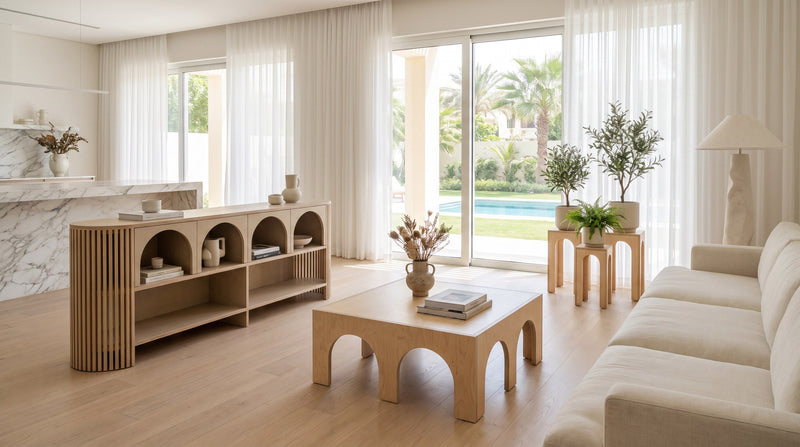
Floor-to-ceiling glass is normal in Dubai, and direct sun is the one thing that changes the look of birch over time. It does not damage the sealer; it warms the tone of the wood. A pale piece that spends its afternoons in full sun will mellow towards honey over the years, and unevenly if something sits in one spot for months. Lift the vase and there is a pale shadow where it stood.
The fix is easy: sheer curtains in the afternoon, and move the objects on top around now and then so the surface ages as one piece. You cannot turn a Boho Soul birch plywood sideboard round every few months, so if it lives on the window wall, rotate what sits on it and let the sheers do the rest. In our experience the shift is most visible on Natural, where the pale birch is the whole colour; on Snow, Sand and Smoke the stain gives the eye something else to read.
Air-conditioning dryness and summer humidity
Indoors in Dubai is cool and dry for most of the year, then humid the moment the AC is off in summer or a door is left open in August. Windows sweat in the mornings. Solid timber can split across a wide board in that swing; chipboard swells at the edges and stays swollen. Plywood, because its layers pull against each other, moves very little, and a sealed piece takes the change in its stride. What to avoid is standing moisture and extremes of temperature, not the ordinary rhythm of the seasons.
- Keep pieces a hand's width off an exterior wall that sweats in summer, so air moves behind them.
- Do not put a cabinet directly under an AC unit that might drip.
- If you leave for the summer with the AC off, pull furniture away from the windows and do not shut damp towels inside a cupboard.
- Balconies, terraces and shower rooms are not places for sealed plywood. It is indoor furniture.
- Leave air under a bed. The slatted base of the Sofi floor bed is there so the mattress breathes when the humidity comes in.
Tiled floors: felt pads and skating
Almost every floor in the UAE is porcelain or marble. Tile is hard, and the grain of sand that blows in under the door is harder. A piece dragged across a tile with sand under one foot leaves a line you cannot polish out. Felt pads under every foot stop the piece scratching the floor and stop it skating every time a door or drawer is opened. Check them after a deep clean; wet mopping loosens them. On a rug, use a non-slip underlay so the piece does not walk.
Situation by situation
| Situation | Do | Don't |
|---|---|---|
| Daily dust and fingerprints | Damp, wrung-out cloth with the grain, then a dry cloth | Spray polish, disinfectant wipes every day |
| Sticky marks, kids' snacks | Mild washing-up liquid in water, cloth wrung out, dry after | Cream cleaners, scouring pads |
| Spilled drink | Blot straight away, dry the surface | Rub, or leave it to dry on its own |
| Hot cup or plate | Coaster or mat | Put it straight on the wood |
| Window wall, afternoon sun | Sheers, rotate what sits on top | Leave the same object in place for months |
| Summer humidity, AC off | Keep a gap off exterior walls, air the cupboards | Store damp things inside, push it against a sweating wall |
| Tiled floor | Felt pads under every foot, check after mopping | Drag it, or mop up against the base |
| Balcony or terrace | Keep it indoors | Use indoor plywood outside, even under cover |
| Moving apartment | Empty it, wrap it, lift it with two people | Drag it, stack boxes on it, tape the bare surface |
| Scuff or ring that will not lift | Send us a photo | Sand it or re-stain it yourself |
Moving house
Families in the UAE move often, and most damage we see happens in a van, not a living room. Empty the piece and lift out any loose shelves. Wrap it in a moving blanket with film over the blanket, never tape on the bare surface; tape lifts the sealer when it comes off. The film holds doors and drawers shut. Then two people lift it. Nobody drags it, and nobody tips a tall cabinet onto its back and slides it.
In the van it travels upright with nothing stacked on top. If it has to sit in storage over a summer, choose a unit with air-conditioning; a sealed container in August is the one place we would not put plywood. At the new place, put the felt pads back on before it goes into position.
Refreshing a piece years later
Birch plywood ages well. A sideboard that has been wiped and kept out of the worst sun for years usually needs nothing more than a proper clean and a fresh set of felt pads. The exposed layered edges, which people worry about most, are the part that ages best, because they are sealed and there is nothing to chip.
Where a piece has had a harder life, a scuffed top or a knocked door edge, do not sand it at home. On Snow, Sand or Smoke the stain sits in the top of the wood and the sealer over that; sand through and you have a pale patch no cloth will fix. Message us with photos instead. Depending on the piece and the finish, a light re-seal or a small repair may be possible in the workshop, and we would rather tell you honestly what can be done than have you try a sanding block first.
From the workshop
The care advice above is the routine we use on the bench. When a piece is finished, the sealer goes on every face and every edge, including the underside, the back and the inside of the doors, because a single raw face is all humidity needs. The layered edge of the ply is sanded through several grits before it is sealed, so it ends up as one smooth surface rather than a stack of stripes. Before wrapping, the last person to touch the piece runs a damp cloth over it, then a dry one, then a hand around every edge. That is the whole method. If it needs more than that in your home, something has gone wrong, and we want to know.
Frequently asked questions
Can I use antibacterial wipes on plywood furniture?
Occasionally, on a kids' table, yes, then wipe with a damp cloth. As a daily habit, no; they dry out the sealer. Mild soap in water does the same job.
What happens if water sits on the surface?
A sealed surface shrugs off a spill wiped up within minutes. Standing water left for hours can leave a dull mark, and water left overnight at a joint can find a way in. Blot it, dry it, and use coasters.
Will birch plywood change colour in the sun?
Yes, slowly. Direct sun warms the tone of birch towards honey over years. It is not damage. Sheers and moving the objects on top keep the change even. The shift is most visible on Natural.
Do I need to oil or wax it?
No. The sealer is the finish. Oil or wax on top of it sits there, attracts dust, and makes any future refresh harder. A damp cloth and a dry cloth are all it needs.
Can an old Plyconcept piece be refreshed?
Often, yes. Send photos through WhatsApp or the contact page and we will tell you what is possible. Do not sand or re-stain it yourself; on a stained piece that leaves a pale patch.
Is the care different for children's furniture?
No. Same sealer, same routine. The Sofi range is finished exactly as the sideboards are.
Talk to the workshop
If a piece has a mark you cannot lift, you are about to move, or you want to know whether an older piece can come back for a refresh, message us on WhatsApp with a photo or use the contact page. We make every piece to order in our Dubai workshop and would rather answer a question than see a piece sanded. For workshop news and new pieces first, the newsletter sign-up is in the footer.